
In the past decade or so, many in literacy education have been shifting their instructional practices based on new learning about the Science of Reading (SoR) and, in recent years, the Science of Learning (SoL). There has been an onslaught of information for educators, administrators, lawmakers, and parents to digest. More importantly, questions abound about how to integrate the two bodies of work then, most importantly, how to translate it into effective, efficient instructional practices that best benefit students and improve their literacy outcomes.
The first step is a general understanding of the SoR and the SoL and what is contained in each. If you are someone who likes to take a deeper dive, a simple Google search will provide countless resources for that!
The Science of Reading is a body of research from neuroscience, cognitive science, linguistics, education, and psychology. This body of research informs what happens in the brain when learning to read, what makes reading challenging, and what types of instructional practices will most likely be beneficial.
Areas studied in the Science of Reading:
- Spoken language
- Listening and speaking, and understanding spoken language, are imperative precursors to reading.
- Spoken words are represented in print with letters
- English is a code.
- Accuracy when reading words and text
- Emerging readers are laborious at sounding out words at first and become automatic over time.
- Fluency and automaticity when reading text
- Reading smoothly, like you talk, with accuracy provides opportunity to access meaning.
- Expanding Vocabulary
- Knowledge of the meaning of words, and word parts, expands understanding.
- Background Knowledge
- Expanded knowledge on various topics lends itself to pursuing deeper knowledge more easily.
- Comprehension
- Understanding what is read is the ultimate goal of reading.
The Science of Learning is a body of research from multiple disciplines, as with the SoR. It researches the foundations of learning and how to help more effectively facilitate learning.
Areas studied in the Science of Learning:
- Cognitive Load
- The mental effort it takes to do a task impacts learning.
- Interleaving
- This is practicing two or more skills or subjects at the same time as opposed to mastery or massed practice before moving on.
- Attention
- In order to learn something, we need to attend to it.
- Working Memory
- The brain can only hold a limited amount of information at one time.
- Spaced Practice
- Revisiting information over time and recalling it to be used again strengthens learning as opposed to cramming.
- Retrieval Practice
- Remembering what you learned, instead of being told or looking at notes or a text, solidifies learning.
- Productive Struggle
- Struggle before a solution deepens learning.
- Transference
- What was learned should be useable somewhere else, not just in the situation where it was taught.
- Explicit Teaching
- Beginners new to learning a process benefit from clear explanations, modeling, practice, and feedback as opposed to discovery.
Before moving on, I want to point out that excellent research and a scientific basis support writing, handwriting, and spelling. For the sake of avoiding cognitive overload for you, the reader, I’ll save those for another time!
A burning question many have is this:
How can I incorporate the SoR and SoL together,
and what does it look like when teaching students to read?
This topic is dear to my heart as EBLI has incorporated both since its inception in 2003.
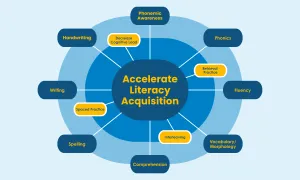
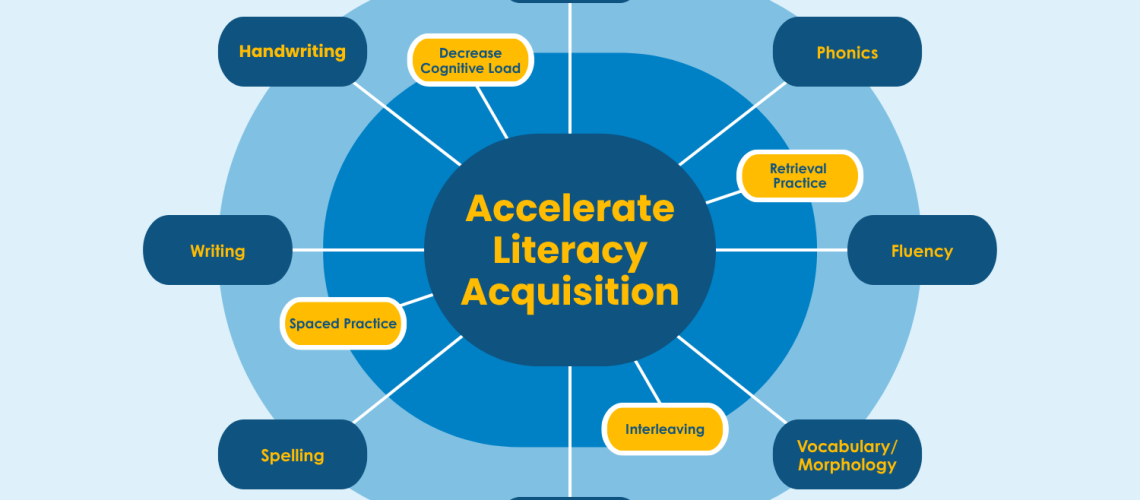
Integrated instruction is a staple of utilizing the components of the SoR and SoL. For example, instead of teaching phonics, phonemic awareness, spelling, vocabulary (including morphology), fluency, and comprehension in isolation, teach them in an integrated manner.
What might this look like? If your science curriculum has the word electrician in 2nd grade, here is what it might look like with integrated instruction:
The EBLI process of one activity: Multi-Syllable Spelling of a word from text before reading (EBLI teaches spelling to teach reading)
- Discuss the meaning.
- Tell students the word is electrician and discuss the meaning (with them doing most of the talking and you redirecting them as needed). Have them include examples of using the word in a sentence.
- SoR components: Spoken Language, Vocabulary, Background Knowledge
- SoL components: Cognitive Load, Explicit Teaching, Retrieval Practice
- Guide the students to spell the word.
- Coach students to write placeholders on their whiteboard for syllables and sounds, then have them retrieve spellings for the sounds to put on the lines. Provide corrections after students are finished, including a step to help them remember any spellings that were initially misspelled. After that, point out the root ‘electric’ meaning ‘relating to electricity’ and suffix ‘cian’ meaning ‘person’. Then the students erase and say and write the word together on the board.
- SoR components: Spoken Language, Spoken Words are Represented with Letters, Accuracy
- SoL components: Cognitive Load, Interleaving, Attention, Working Memory, Retrieval Practice, Productive Struggle, Explicit Teaching, Transference
- Coach students to write placeholders on their whiteboard for syllables and sounds, then have them retrieve spellings for the sounds to put on the lines. Provide corrections after students are finished, including a step to help them remember any spellings that were initially misspelled. After that, point out the root ‘electric’ meaning ‘relating to electricity’ and suffix ‘cian’ meaning ‘person’. Then the students erase and say and write the word together on the board.
- Tell students the word is electrician and discuss the meaning (with them doing most of the talking and you redirecting them as needed). Have them include examples of using the word in a sentence.
- Have the student read the text that the word was pulled from.
- This can be anywhere from supported reading with teacher corrections as needed to independent reading, depending on the ability level of the students.
- SoR components: Spoken Language, Spoken Words are Represented with Letters, Accuracy when Reading Words and Text, Fluency and Automaticity, Expanding Vocabulary, Comprehension
- SoL components: Cognitive Load, Interleaving, Attention, Working Memory, Spaced Practice, Retrieval Practice, Transference
- This can be anywhere from supported reading with teacher corrections as needed to independent reading, depending on the ability level of the students.
When incorporating these various components, HOW instruction is delivered is as important, if not more so, then what is taught. This is nuanced, in the instruction and support as well as pertaining to the student(s) receiving the instruction. It is an experience of trial and error, learning what works best for your particular class or child.
For example, providing information before a student has a chance to try takes away an important learning opportunity and can hinder progress. Instead, allow the student to try first, then provide support and ensure success. Never allow them to struggle without redirecting with corrective feedback, however, as it can lead to student anxiety and withdrawl. Navigating nuances like this when teaching to ensure learning can be a balancing act.
I invite you to join me for the free Science of Reading and Science of Learning webinar where I will go deeper into this and share examples to expand on integrated instruction and addressing these nuances.
What I’ve learned in my years of training teachers and teaching students is that my learning is forever a work in progress. I continuously learn from others, including the teachers and students I teach, and greatly appreciate it.
Here’s to the continuous expansion of our own learning and, especially, expanding the learning of all the students we teach!

Nora Chahbazi, B.S.
Founder, EBLI Evidence-Based Literacy Instruction
Nora has dedicated over 25 years to improving reading instruction. She founded EBLI: Evidence-Based Literacy Instruction and has trained thousands of educators worldwide, teaching learners of all ages and abilities.
She has spoken at numerous conferences, including Plain Talk for Literacy and The Reading League. Nora collaborates with schools as well as organizations focused on implementing research-based teaching practices to promote high-level literacy for all.
Nora served as the literacy consultant for the documentary The Truth About Reading and participated in discussions after screenings, including at the SXSW film festival. She is on the board of The Reading League Michigan.
Nora has appeared in various media, including Emily Hanford’s Sold a Story podcast, the PBS documentary Building the Reading Brain, and an interview on Oprah Radio with Maya Angelou.
She is committed to the mission of teaching the world to read.