Evidence
Grounded in Science.
Proven in Practice.
Independent research demonstrates EBLI’s effectiveness across core instruction, intervention, and special education settings.
2,500+
Students across studies (2005 – 2025)
37% → 100%
Proficiency growth (DIBELS) in 1 year
ESSA
Tier 3 Promising Evidence
New Research — Coming Soon
EBLI vs. Orton-Gillingham
Hyde Park Comparative Study
A within-student comparison measuring growth rates for the same students during Orton-Gillingham instruction versus EBLI instruction.
1.5×
more growth per year with EBLI compared to prior OG instruction
Evidence & Results
ESSA Tier 3
The Every Student Succeeds Act (ESSA) is the federal standard for evaluating whether education programs work. EBLI has earned Tier 3 status — meaning independent, correlational studies with statistical controls have shown positive student outcomes. This qualifies EBLI for Title I, II, and IV funding and meets the evidence bar for most district procurement processes. These three implementations are the studies behind that designation.
Grand Rapids Area Elementary
Delivered by:
Kindergarten classroom teacher using EBLI methods
Setting:
Title I school, 81% FRL, diverse demographics
Measure:
Acadience Reading Composite Scores (BOY → EOY)
Sample size:
14–27 students per assessment period
Cumulative Results (2 Years with EBLI)
At or Above Grade Level
40%
70%
+30 pts avg
Well Below Grade Level
43%
9%
−34 pts avg
Michigan District
Dosage:
Daily EBLI instruction + coaching calls
Delivered by:
35 classroom teachers across 3 schools
Measure window:
Fall 2023 → Spring 2024 → Fall 2024 (MAP Growth)
Sample size:
n=815 students, Grades K-5
Met Fall-to-Fall Growth (Pre-EBLI cohort)
42%
Met Fall-to-Fall Growth (EBLI cohort)
58%
↑ 16 pts
Grades K-4 vs. National Norms
Outperformed
Massachusetts District
Dosage:
30 min/session, 3-5x/week (small group)
Delivered by:
Reading specialists & special education teachers
Measure window:
Fall → Spring (DIBELS, MCAS state test)
Sample size:
n=49 students, Grades 3-6 (29% SPED)
Started Below/Well Below Grade Level
100%
Reached Grade Level by Spring
37%
Passing on State Test (MCAS)
88%
The Science Behind EBLI
Built on Linguistic Phonics
Linguistic Phonics is a research-aligned approach to literacy instruction developed from the work of cognitive psychologist Diane McGuinness. It starts with what every child already knows — spoken language — and teaches them how print maps to the sounds they already use. This is the foundation of EBLI.
Why the Direction Matters
Most phonics programs start with letters, teaching them in isolation, starting with the letter name and sound— a print-to-speech orientation. This is oriented around the letters and the rules to manage them. This requiries memorizing hundreds of letter-sound correspondences, phonics rules and their exceptions, syllable types, and declarative knowledge (vocabulary such as dipthongs, fricatives, and schwa).
Linguistic Phonics reverses the direction. It starts with the child’s spoken language, starting with words they know., isolating the sounds, then matching the spellings to the sound This speech-first instruction simplifies and accelerates reading and spelling acquisition by highlighting patterns in the alphabetic code, which aligns with how the brain learns best, and incorporating the alphabetic principle by attaching the man-made symbols (letters) to the the sounds that represent them in words (speech).
The result: Reading, spelling, and writing acquisition are simplified and accelerated, avoiding cognitive overload for students. Instruction is integrated from the start and applied immediately to reading and writing — not taught as separate skills bolted together and applied later.
Two Orientations to the Alphabetic Code
Traditional Phonics, Print-to-Speech Approach
Letters, which are man-made, lead instruction
Linguistic Phonics, Speech-to-Print Approach
Sounds, which are natural, lead instruction
FOUNDATIONAL RESEARCHER
Diane McGuinness, PhD
Cognitive Psychologist · University of South Florida (Emeritus)
Coined the term “Linguistic Phonics” and developed the foundational analysis of the English alphabetic code that EBLI’s methodology is built on. Her work demonstrated that starting from speech — not print — aligns instruction with how the brain actually processes language.
Why Our Children Can't Read (1997) · Early Reading Instruction: What Science Really Tells Us (2004)
PEER-REVIEWED JOURNAL ARTICLE
Newman & Cvetkovic
SLP · Literacy Researcher & Interventionist
Published the peer-reviewed case for Linguistic Phonics in The Educational Therapist, examining how LP accelerates student learning, reduces teacher workload, and improves outcomes — with direct reference to EBLI’s approach.
PROGRAM DEVELOPER
Nora Chahbazi
Founder, EBLI · Literacy Educator & Researcher
Developed Evidence-Based Literacy Instruction (EBLI) directly from McGuinness’s Linguistic Phonics principles. Over 20+ years, she built a complete instructional system — phonics, vocabulary, fluency, comprehension, handwriting, and writing — with proven outcomes across thousands of students.
PRACTITIONER RESEARCHER
Stephane Bolton, Ed.S.
1st Grade Teacher · Kilby Laboratory School, University of North Alabama
National Board Certified Teacher and 2025–26 Goyen Literacy Fellow with 20+ years of experience. In her first year implementing EBLI, 100% of her first graders reached grade-level benchmark — up from 37% at the start of the year — achieving a median of 184% of typical growth. Her peer-reviewed case study, published in the IALS Journal, documents these outcomes alongside gains in spelling, fluency, and student confidence.
Supporting Research
The Broader Science of Speech-First Instruction
Beyond EBLI’s own outcomes, a growing body of peer-reviewed research demonstrates that intensive, speech-first phonological instruction produces measurable changes in brain activation, white matter development, and reading outcomes — particularly for students with dyslexia.
Dyslexia-Specific Brain Activation Becomes Normal Following Successful Remedial Training
Simos, Fletcher, et al · 2002 · Peer-reviewed
Brain imaging study. Magnetic source imaging of 8 children (ages 7–17) with dyslexia showed that brain activation patterns normalized after 80 hours of intensive remedial instruction — demonstrating that the brain can be retrained through targeted phonological intervention. 8 typical readers served as controls.
Rapid and Widespread White Matter Plasticity During an Intensive Reading Intervention
Huber, Donnelly, Rokem & Yeatman · 2018 · Peer-reviewed
White matter MRI study. Diffusion MRI data collected at regular intervals during an 8-week intensive reading intervention revealed large-scale changes across white matter tracts, occurring in concert with measurable growth in reading skill.
Live Webcam Coaching to Help Early Elementary Classroom Teachers Provide Effective Literacy Instruction for Struggling Readers
Targeted Reading Intervention · 2017 · Randomized Controlled Trial
385 students across 15 schools (220 intervention, 165 comparison). Kindergarten and first-grade teachers identified struggling readers who were randomly assigned to groups. Effect sizes of .36 to .63 on standardized reading tests.
An Evaluation of Intensive Intervention for Students with Persistent Reading Difficulties
Denton, Fletcher, et al · 2006 · Peer-reviewed
Tertiary intervention study. 27 students with severe reading difficulties received a 16-week intensive intervention using the Phono-Graphix decoding program — including 14 who had not responded adequately to 1–2 prior tiers of reading instruction. Published in the Journal of Learning Disabilities.
Dig Deeper
Learn more about EBLI and LInguistic Phonics from a variety of perspectives.
YOUTUBE
"Merging the Science of Reading with the Science of Learning"
Hosted by the Paradigm Shifters Collaborative
In this panel presentation, program creators and literacy teachers share the research behind and principles of Linguistic Phonics and focus on how this approach bridges research with instructional implementation.
PEER-REVIEWED RESEARCH · WEBINAR
"Re-examining Foundational Literacy Instruction"
Jennifer Newman and Svetlana Cvetkovic interviewed by Nora Chahbazi
A conversation with the authors of the peer-reviewed paper making the case for Linguistic Phonics instruction in the United States — exploring why the evidence points to a speech-to-print approach and what it means for how we teach reading.
Educator Perspectives
From Teachers Using EBLI
Real results from Kindergarten, 1st, and 2nd grade classrooms.
Kindergarten
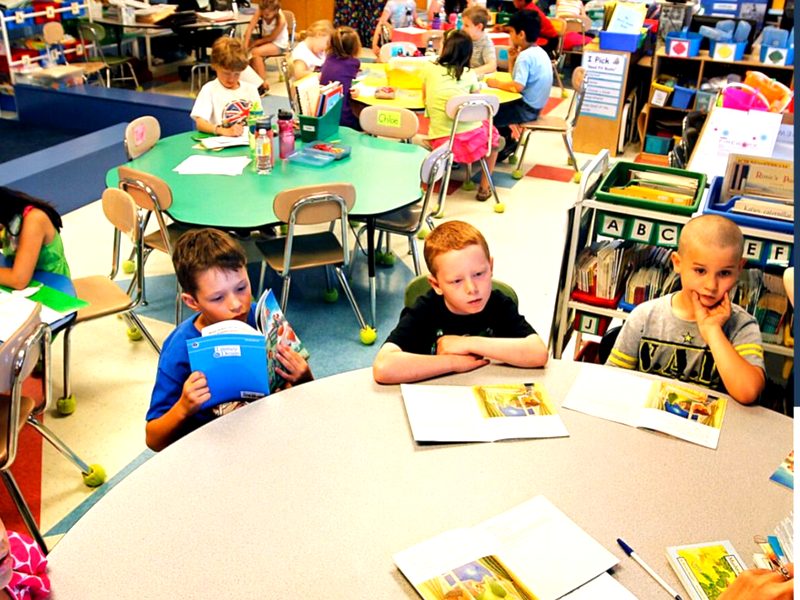
92-100%
of students at grade level by year end
Julie VanLier · 21 years teaching
High-poverty school, Kentwood Schools, Grand Rapids · Title I · 26–28 students per class
With EBLI: 4 years of iReady data — 92–100% of students at grade level by end of year, every year. 106 students across 4 cohorts, starting as low as 18% at benchmark. Zero behavior problems during the 45-minute literacy block.
1st Grade
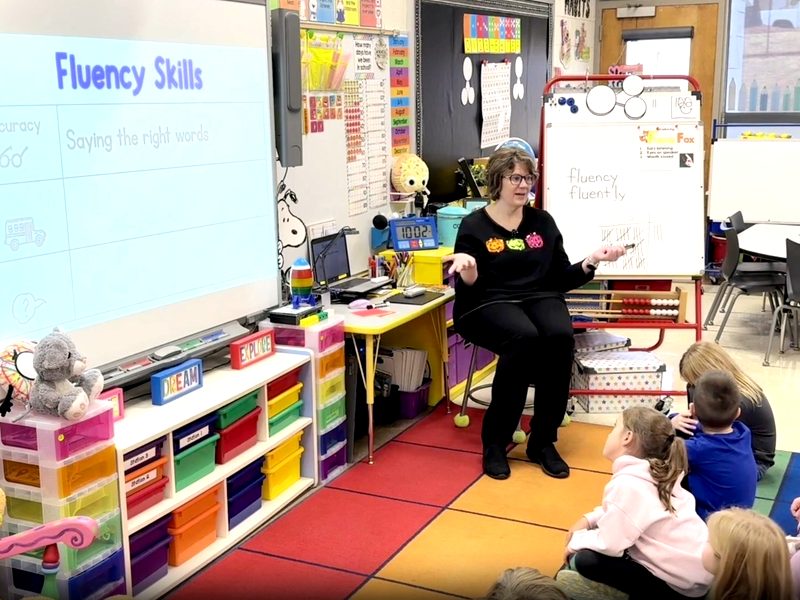
184%
average growth on iReady
Stephane Bolton, Ed.S. · 20+ years teaching
National Board Certified · 2025 ALA Outstanding Literacy Teacher
With EBLI: 100% of students at grade-level benchmark by spring (up from 37%). One student went from reading 3 words per minute to eager, motivated reader. Students now say “I love reading and writing.”

2nd Grade
5-paragraph
essays from 2nd graders
Alicyn Cawley · 20 years teaching
Pioneer Union Elementary, California
With EBLI: One lesson covers reading, writing, spelling, phonics, and grammar. Students ask “Do we get to do EBLI again?” 100 times a day.
Implementation Requirements
For the Greatest Literacy Outcomes with Students, Follow These Guidelines:
EBLI outcomes depend on specific implementation conditions. Here’s what successful schools and districts have in place:
Instructional Time
Core instruction: Daily use within literacy block for 30-60 minutes
Intervention: 30-60 minutes/session, 1-5 days/week
Best results: Be consistent with teaching EBLI processes and methodology while implementing print-to-speech practices.
Teacher Training
Orientation: 4-6 hours asynchronous (theory, platform, assessment, materials)
Total training: 40-60 hours, integrated teacher training and student instruction
Model: Learn EBLI while teaching your class, group, or individual student(s); video support fades as confidence builds
Materials & Platform
Included: EBLI Teacher Training & Student Lessons (ETSL) platform with videos, training modules, student instruction, printable materials
Ready-to-go: Activities, materials, text to read, and lessons planning are all provided.
Access: 1-year ETSL access included with training
Ongoing Support
Coaching: Monthly live Zoom calls to enhance your learning, ask questions, refine practice
Video library: 3,000+ additional EBLI videos, K-12
Community: Access to private EBLI support FB group