Sept. 8 Blog Image_V1_Riopelle_23.09

Rare National Certification Awarded to Michigan Teacher Training System

Product Certification Provides Transparency to Edtech Marketplace

SEPTEMBER 2023 | Washington, D.C. – The K-5 Classroom EBLI Teacher Training & Student Lessons (ETSL) has earned the Research-Based Design for Instructional Learning Products: Product Certification from Digital Promise. This Product Certification serves as a rigorous, reliable signal for district and school leaders, educators, and families looking for edtech products with a confirmed basis in research about learning.

EBLI submitted evidence to Digital Promise confirming a link between research on how students learn and the product’s design. EBLI also demonstrated their commitment to making their research basis clear and accessible to the public.

“More than 8,000 products are used in K-12 schools and fewer than 1 percent have earned this recognition,” said Rachel Schechter, Ph.D., Learning Experience Design (LXD) Research, who worked with EBLI in preparing the application.

“It’s a great honor for ETSL to receive Digital Promise’s Product Certification,” said EBLI Founder Nora Chahbazi. “ETSL is decades long in the making and is a labor of love by the devoted EBLI team, who are extremely dedicated to providing world class instruction for teachers and students.”

“Educators and researchers continue to uncover important insights about how people learn,” said Christina Luke Luna, Chief Learning Officer, Pathways and Credentials at Digital Promise. “Digital Promise’s Research-Based Design Product Certification recognizes the edtech products that incorporate research about learning into their design and development. Congratulations to K-5 Classroom ETSL for demonstrating that research informs product design!”

Through Product Certifications, consumers can narrow their options as they select products based on research about learning before trying it out in their classrooms. Digital Promise launched the Research-Based Design Product Certification in February 2020 and has certified over 70 products to date.

The Research-Based Design Product Certification uses a competency-based learning framework, developed in consultation with Digital Promise’s Learner Variability Project advisory board, expert researchers in the Learning Sciences field, and nearly 50 educators across the United States. Further detail about its development can be found in Digital Promise’s reports, Designing Edtech that Matters for Learning: Research-Based Design Product Certifications (2020) and An Overlooked Indicator of Edtech Quality: The Use of Learning Sciences Research (2022).

All developers, educators, edtech investors, and families are also encouraged to sign the Research-Based Product Promise and demand high-quality, research-driven products that support each unique learner. More information on Digital Promise’s Product Certifications can be found at productcertifications.digitalpromise.org.

About EBLI

EBLI: Evidence-Based Literacy Instruction was created by Nora Chahbazi in 2003. EBLI’s streamlined methodology, utilizing a Structured Linguistic Literacy approach, aligns with reading and learning science and is delivered via EBLI Teacher Training & Student Lessons (ETSL). The world class training, unmatched teacher support, revolutionary student instruction in reading, spelling, and writing, and built-in structure included with ETSL provides teachers with the opportunity to advance their knowledge, refine their instruction, and bridge research with teaching students in their classroom. EBLI’s mission is to teach the world to read. To learn more, visit www.ebli.com.

About LXD Research

Learning Experience Design Research is an independent evaluation and research firm within Charles River Media Group focusing on educational programs. We specialize in research communication, efficacy study validation, and the design and execution of ESSA-aligned research studies. Visit www.LXDResearch.com.

About Digital Promise

Digital Promise is a nonprofit organization that builds powerful networks and takes on grand challenges by working at the intersection of researchers, entrepreneurs, and educators. Our vision is that all people, at every stage of their lives, have access to learning experiences that help them acquire the knowledge and skills they need to thrive and continuously learn in an ever-changing world. For more information, visit the Digital Promise website and follow @digitalpromise for updates.
Stephane Bolton has spent more than two decades teaching first graders to read. She holds a Bachelor’s degree in elementary education, a Master’s degree, and an Education Specialist degree — all from the University of North Alabama. In 2011, she received National Board Certification and renewed it in 2020. She has served as an instructional coach and an assistant principal. By any measure, Stephane was already an accomplished literacy educator.

But she wasn’t reaching every student.

Bolton had trained extensively in phonics instruction over the years — first through the Alabama Reading Initiative, then through LETRS and Orton-Gillingham. Each step forward clarified the picture. As she told journalist Holly Korbey in The Bell Ringer, the Science of Reading training helped her see the puzzle pieces more clearly, and things began to make more sense. But a handful of students continued to struggle, year after year.

Then she discovered EBLI.

The Shift

Bolton found EBLI through the Accelerate Literacy Summit — almost by accident. What caught her attention was how the method streamlined phonics instruction: fewer rules for students to memorize, a lighter cognitive load, and a focus on students picking up sound-letter patterns in words and applying them to reading and writing. It was a fundamentally different approach — Linguistic Phonics, rooted in the speech-to-print methodology that starts with what students already know (spoken language) and maps it to print.

She paid for the training herself.

The Results

What happened next in Stephane’s first-grade classroom during her first year teaching EBLI was remarkable.

2024–2025 School Year (Bolton’s First Year Using EBLI):

Beginning of year (August 2024): 

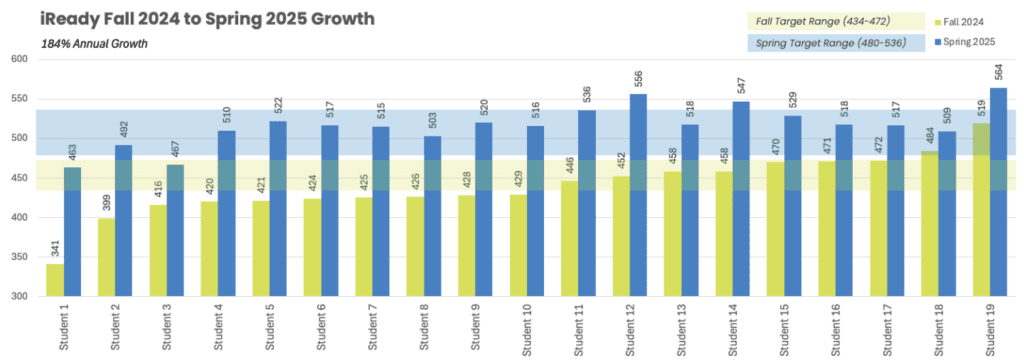
  • 37% of her class was at grade level on the iReady assessment.
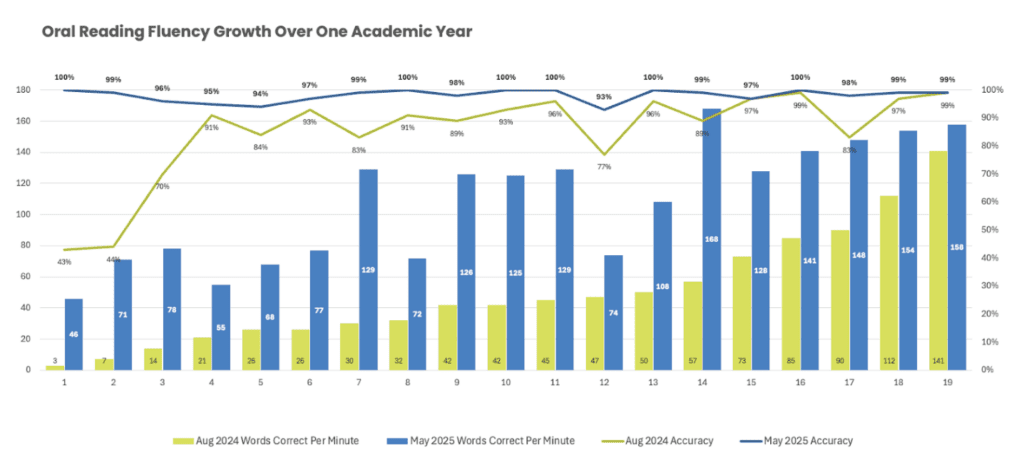
  • The average wpm (words per minute) on DIBELS for the 19 students was 46.9.
  • The average accuracy on DIBELS for the class was 84.9%


End of year (May 2025):

  • 100% of her students were reading at or above grade level on iReady (+63%)
  • Median of 184% of typical growth for iReady
    • The average DIBELS wpm for the class was 108.2 (+58.6wpm)
      • EOY Benchmark for 1st grade is 91 wpm
    • The average accuracy was 98.1% (+13.2%)
      • EOY 1st grade benchmark for accuracy is 91%.
  • Every student was independently reading chapter books by year’s end.

DIBELS Results 8th Edition – Correct Words Per Minute and Percent Accuracy

In Her Own Words

In September 2025, Bolton shared this reflection on her experience with EBLI:

"EBLI has completely transformed the way I teach and the way my students learn. During my first year using EBLI, every child in my class experienced remarkable growth. Struggling readers made leaps that once felt out of reach, while fluent readers progressed far beyond grade-level expectations. One thing that makes EBLI so powerful is its seamless integration of phonemic awareness, phonics, fluency, vocabulary, comprehension, handwriting, writing, and spelling. These skills aren't taught in isolation. Instead, they are woven together in every EBLI activity, giving students constant practice with high-leverage skills. Built on cognitive science, EBLI instruction feels clear and efficient. It reduces the cognitive load for both students and teachers so we can focus on what truly matters. In my classroom, EBLI is everywhere! Reading and writing flow naturally through every subject, and the activities are so engaging that students often beg to do them as rewards. I've watched my first graders grow into resilient, flexible thinkers who genuinely love learning and reading! EBLI has given me more than a method…it has given me a mission! My passion to join EBLI in 'teaching the world to read' now stretches beyond my classroom of students. I've started tutoring during planning times at school and even opened a private practice over the summer to reach more learners. Teaching with EBLI doesn't just feel like instruction; it feels like a calling, because every person deserves the richness of a literate life."
Stephane Bolton
First Grade Teacher, Kilby Laboratory School

Who Is Stephane Bolton?

Stephane is the first-grade supervising teacher at Kilby Laboratory School, a public laboratory school on the campus of the University of North Alabama in Florence, Alabama. Kilby is ranked among the top 5% of elementary schools in Alabama for overall test scores, with 80–84% of students achieving reading proficiency — compared to the state average of 47%.

Accomplishments: 

Two articles about her EBLI experience published in peer-reviewed journals: 

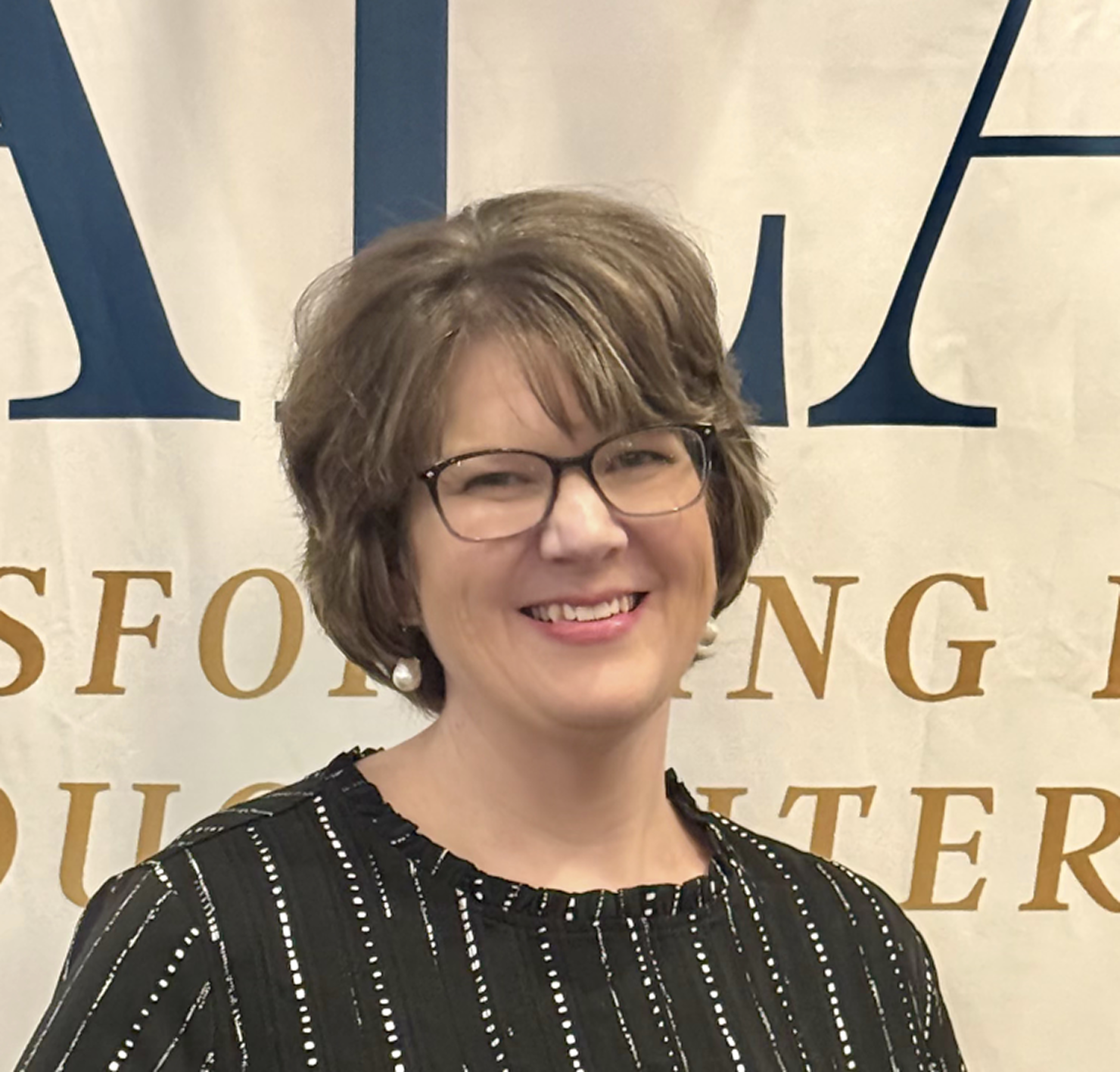
Recipient of ALA Outstanding Literacy Teacher Award, 2025

Recipient of ALA Outstanding Literacy Teacher Award, 2025

Founded Primary Patchwork Learning Center, 2025

  • Stephane teaches EBLI privately to students after school, on weekends, and during the summer.

Goyen Literacy Fellow, 2025

Presenter (by request), Alabama Literacy Association conference, Fall, 2025

  • Follow the Yellow Brick Road: A Speech-to-Print Journey to Stronger Literacy

Featured Holly Korbey’s “The Phonics Wars” article, February 2026

Why This Matters

Bolton’s story matters because she is not a newcomer. She had decades of training in teaching reading, Science of Reading frameworks, and evidence-based practices before she found EBLI. She had already been doing the work. And yet, it was the shift to Linguistic Phonics — the speech-first, streamlined approach that EBLI uses — that closed the gap for the students she hadn’t been able to reach before.

Her experience mirrors what EBLI’s independent research has shown across larger studies: in a Michigan study of 815 students across 35 classrooms, 58% of K–4 students met fall-to-fall growth expectations with EBLI, compared to 42% in the pre-EBLI cohort. In a Massachusetts intervention study, 37% of students reached grade level and 88% passed the state assessment. And in Grand Rapids, the percentage of students at or above grade level rose from 40% to 70%.

Bolton’s classroom data adds a powerful individual case to this growing body of evidence — one teacher, one classroom, and the outcome every educator hopes for: every student reading.

Want to learn more about EBLI training? Explore Training Options 

See the full research behind EBLI: View Evidence

 
  • Bolton, S., Tomlinson, A., Kirkman, E. (2025) Elevating Literacy Through Evidence-Based Practice: A Case Study in Innovation at Kilby Laborators School, IALS Journal. Read the Journal. 
  • Bolton, S. (2025) Teaching with Clarity: The Power of Speech-to-Print Instruction, The Reading Paradigm (2025). Read the article
  • Bolton, S. (2025). Teaching less and learning more: Five shifts that maximized growth. Science of Reading Classroom. Read the post
  • Bolton, S. (2025). “A Closer Look at EBLI: Bringing the Five Shifts to Life.” Science of Reading Classroom (Substack). Read the post
  • Bolton, S. (2025). “Fluency in 1st Grade: An Introduction.” Science of Reading Classroom (Substack). Read the post
  • Korbey, H. (2026). “The Phonics Wars.” The Bell Ringer (Substack). Read the article
  • EBLI Facebook page, sharing Bolton’s data from the 2024–2025 school year
  • Goyen Literacy Fellowship. Goyen Foundation. Learn more
  • ESSA Research on EBLI, independent efficacy studies. See results

Share this post

Recent Blogs

×