why-ebli-was-created-image-1-p0vl8vcecl3ru6u4cn1f3rcyr4i8i131i5foadlfuw

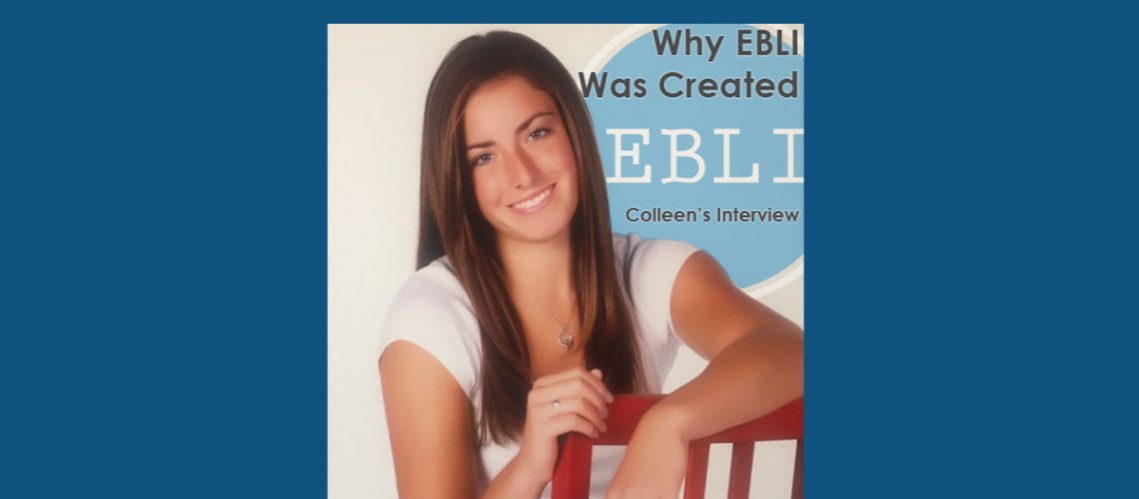
Why EBLI Was Created

“The journey of a thousand miles begins with a single step.” – Lao Tzu

Colleen, my middle daughter, has always been bright, kind-hearted, and curious. Her reading challenges in 2nd grade, back in 1997, were the impetus that led to the creation of EBLI. Besides struggling significantly with reading and spelling at that time, she lacked confidence, was self-conscious, and had low self-esteem.

As any parent knows, watching your own child suffer is excruciating. 

The desperation I felt led to me learn how to teach her to read, leave my profession as an RN, and become a champion for literacy.

WHY EBLI WAS CREATED – COLLEEN’S INTERVIEW

After 3 hours of instruction, Colleen was reading chapter books and comprehending them! Her spelling improved dramatically too. Almost immediately her confidence grew in all areas of life and her self-esteem blossomed.

Whether I’m training teachers, teaching students, or talking about EBLI, the memories of Colleen’s past literacy struggles motivate me to continue to help those who are suffering unnecessarily like she was.

Below, Colleen shares her perspective about her previous difficulties with reading, how they shaped her, and what her life is like now as an adult. I’m tremendously proud of her and enjoyed hearing what she had to say about her experience. I hope you enjoy reading it too!

Before you were taught by your mom, how did you feel about reading?

Colleen: To be honest, I avoided reading like the plague! Growing up I was an almost painfully shy girl and when it came to school, I just wanted to make sure everyone liked me and that I made my parents and teachers proud.

Reading out loud in class was my worst enemy. I was forced to be the center of attention and it was something that didn’t come naturally to me like math and science did.

Reading was a skill I always wished I had because I was very curious, loved learning and LOVED stories. One of my favorite times of the day was snuggling in bed while my mom read to my sisters and me. Reading just seemed like a puzzle I couldn’t solve and something I was missing out on.

Why did she teach you?

Colleen: She saw my struggle and no mother wants to see their child go through that. I can’t thank her enough for everything she has done for me. She didn’t just accept that I had a problem because I wasn’t on the same track as my sister was or because I was falling behind my class in the subject. That would’ve been the easy thing to do.

Instead, she continued to research and develop and didn’t give up until she found a solution that worked. That makes her one amazing mother if you ask me. She is Superwoman in my eyes!

What changes did you notice as you progressed through your instruction (and how quickly did they occur)?

Colleen: I noticed a difference right away. The instruction didn’t make reading seem as daunting as it was before. The way the words were broken up and the logic of it made sense to me. Before that, reading seemed foreign.

What changes did you notice after you were finished?

Colleen: I actually enjoyed reading! I finished my first chapter book cover to cover quickly and could recall the entire story without having to go back and re-read every page. Before, I would just give up because the time it took didn’t seem worth it and it was an extremely frustrating process.

What is your life like now (what do you do, how do you feel about reading, etc.)?

Colleen: I currently live outside of Chicago and do Marketing and Event Coordination for a yacht charter company downtown. I was married in 2018 and am expecting our first child in March (2021). I still love reading and it is an addictive pastime that I try to do whenever I get the chance. I can’t imagine how different my life would’ve been had I not been taught by my mom.

I went from the possibility of being in special education classes to graduating from high school with honors. This led to earning an academic scholarship at my college where I was a student athlete and graduated with a degree in Business Marketing.

Learning to read well also worked wonders on my confidence. People who meet me now have a hard time believing I was ever shy. I will forever be grateful to my mom for how she transformed my life. I am so proud of her for sharing her knowledge and using it to help others of all ages and backgrounds so they don’t have to struggle like I did.
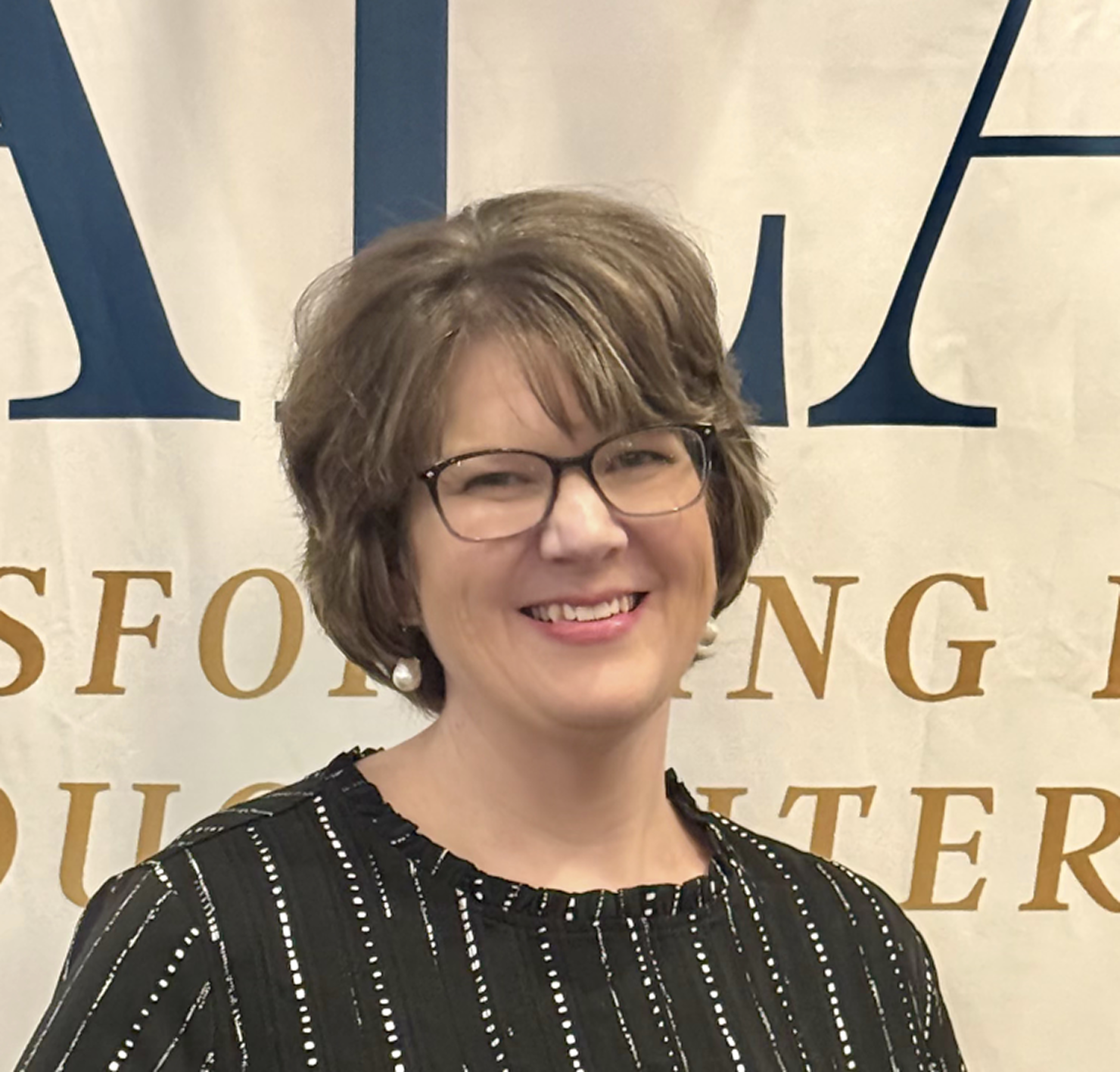
Stephane Bolton has spent more than two decades teaching first graders to read. She holds a Bachelor’s degree in elementary education, a Master’s degree, and an Education Specialist degree — all from the University of North Alabama. In 2011, she received National Board Certification and renewed it in 2020. She has served as an instructional coach and an assistant principal. By any measure, Stephane was already an accomplished literacy educator.

But she wasn’t reaching every student.

Bolton had trained extensively in phonics instruction over the years — first through the Alabama Reading Initiative, then through LETRS and Orton-Gillingham. Each step forward clarified the picture. As she told journalist Holly Korbey in The Bell Ringer, the Science of Reading training helped her see the puzzle pieces more clearly, and things began to make more sense. But a handful of students continued to struggle, year after year.

Then she discovered EBLI.

The Shift

Bolton found EBLI through the Accelerate Literacy Summit — almost by accident. What caught her attention was how the method streamlined phonics instruction: fewer rules for students to memorize, a lighter cognitive load, and a focus on students picking up sound-letter patterns in words and applying them to reading and writing. It was a fundamentally different approach — Linguistic Phonics, rooted in the speech-to-print methodology that starts with what students already know (spoken language) and maps it to print.

She paid for the training herself.

The Results

What happened next in Stephane’s first-grade classroom during her first year teaching EBLI was remarkable.

2024–2025 School Year (Bolton’s First Year Using EBLI):

Beginning of year (August 2024): 

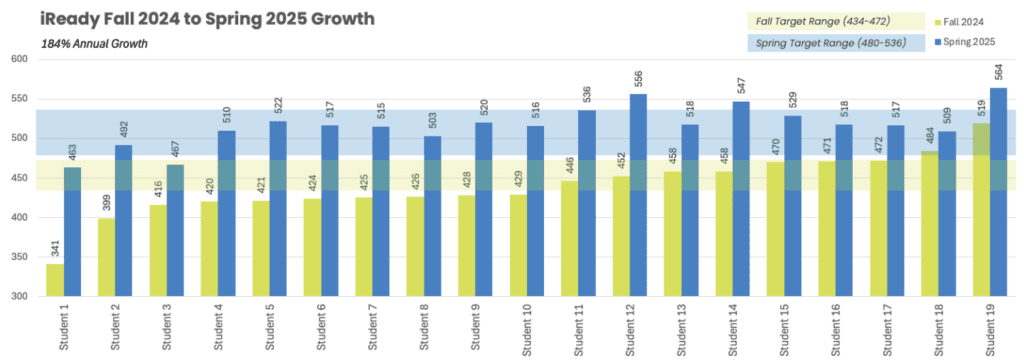
  • 37% of her class was at grade level on the iReady assessment.
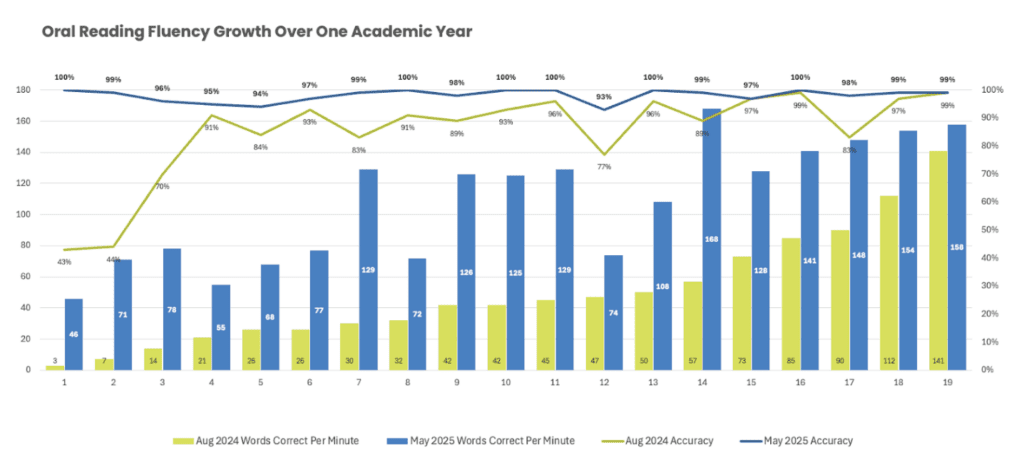
  • The average wpm (words per minute) on DIBELS for the 19 students was 46.9.
  • The average accuracy on DIBELS for the class was 84.9%


End of year (May 2025):

  • 100% of her students were reading at or above grade level on iReady (+63%)
  • Median of 184% of typical growth for iReady
    • The average DIBELS wpm for the class was 108.2 (+58.6wpm)
      • EOY Benchmark for 1st grade is 91 wpm
    • The average accuracy was 98.1% (+13.2%)
      • EOY 1st grade benchmark for accuracy is 91%.
  • Every student was independently reading chapter books by year’s end.

DIBELS Results 8th Edition – Correct Words Per Minute and Percent Accuracy

In Her Own Words

In September 2025, Bolton shared this reflection on her experience with EBLI:

"EBLI has completely transformed the way I teach and the way my students learn. During my first year using EBLI, every child in my class experienced remarkable growth. Struggling readers made leaps that once felt out of reach, while fluent readers progressed far beyond grade-level expectations. One thing that makes EBLI so powerful is its seamless integration of phonemic awareness, phonics, fluency, vocabulary, comprehension, handwriting, writing, and spelling. These skills aren't taught in isolation. Instead, they are woven together in every EBLI activity, giving students constant practice with high-leverage skills. Built on cognitive science, EBLI instruction feels clear and efficient. It reduces the cognitive load for both students and teachers so we can focus on what truly matters. In my classroom, EBLI is everywhere! Reading and writing flow naturally through every subject, and the activities are so engaging that students often beg to do them as rewards. I've watched my first graders grow into resilient, flexible thinkers who genuinely love learning and reading! EBLI has given me more than a method…it has given me a mission! My passion to join EBLI in 'teaching the world to read' now stretches beyond my classroom of students. I've started tutoring during planning times at school and even opened a private practice over the summer to reach more learners. Teaching with EBLI doesn't just feel like instruction; it feels like a calling, because every person deserves the richness of a literate life."
Stephane Bolton
First Grade Teacher, Kilby Laboratory School

Who Is Stephane Bolton?

Stephane is the first-grade supervising teacher at Kilby Laboratory School, a public laboratory school on the campus of the University of North Alabama in Florence, Alabama. Kilby is ranked among the top 5% of elementary schools in Alabama for overall test scores, with 80–84% of students achieving reading proficiency — compared to the state average of 47%.

Accomplishments: 

Two articles about her EBLI experience published in peer-reviewed journals: 

Recipient of ALA Outstanding Literacy Teacher Award, 2025

Recipient of ALA Outstanding Literacy Teacher Award, 2025

Founded Primary Patchwork Learning Center, 2025

  • Stephane teaches EBLI privately to students after school, on weekends, and during the summer.

Goyen Literacy Fellow, 2025

Presenter (by request), Alabama Literacy Association conference, Fall, 2025

  • Follow the Yellow Brick Road: A Speech-to-Print Journey to Stronger Literacy

Featured Holly Korbey’s “The Phonics Wars” article, February 2026

Why This Matters

Bolton’s story matters because she is not a newcomer. She had decades of training in teaching reading, Science of Reading frameworks, and evidence-based practices before she found EBLI. She had already been doing the work. And yet, it was the shift to Linguistic Phonics — the speech-first, streamlined approach that EBLI uses — that closed the gap for the students she hadn’t been able to reach before.

Her experience mirrors what EBLI’s independent research has shown across larger studies: in a Michigan study of 815 students across 35 classrooms, 58% of K–4 students met fall-to-fall growth expectations with EBLI, compared to 42% in the pre-EBLI cohort. In a Massachusetts intervention study, 37% of students reached grade level and 88% passed the state assessment. And in Grand Rapids, the percentage of students at or above grade level rose from 40% to 70%.

Bolton’s classroom data adds a powerful individual case to this growing body of evidence — one teacher, one classroom, and the outcome every educator hopes for: every student reading.

Want to learn more about EBLI training? Explore Training Options 

See the full research behind EBLI: View Evidence

 
  • Bolton, S., Tomlinson, A., Kirkman, E. (2025) Elevating Literacy Through Evidence-Based Practice: A Case Study in Innovation at Kilby Laborators School, IALS Journal. Read the Journal. 
  • Bolton, S. (2025) Teaching with Clarity: The Power of Speech-to-Print Instruction, The Reading Paradigm (2025). Read the article
  • Bolton, S. (2025). Teaching less and learning more: Five shifts that maximized growth. Science of Reading Classroom. Read the post
  • Bolton, S. (2025). “A Closer Look at EBLI: Bringing the Five Shifts to Life.” Science of Reading Classroom (Substack). Read the post
  • Bolton, S. (2025). “Fluency in 1st Grade: An Introduction.” Science of Reading Classroom (Substack). Read the post
  • Korbey, H. (2026). “The Phonics Wars.” The Bell Ringer (Substack). Read the article
  • EBLI Facebook page, sharing Bolton’s data from the 2024–2025 school year
  • Goyen Literacy Fellowship. Goyen Foundation. Learn more
  • ESSA Research on EBLI, independent efficacy studies. See results

Share this post

Recent Blogs

×