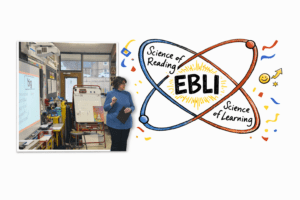
How First Grade Teacher Stephanie Bolton Transformed Her Classroom with EBLI
“EBLI has completely transformed the way I teach and the way my students learn. During my first year using EBLI, every child in my class experienced remarkable growth…”
Stephane Bolton has spent more than two decades teaching first graders to read. She holds a Bachelor’s degree in elementary education, a Master’s degree, and an Education Specialist degree — all from the University of North Alabama. In 2011, she received National Board Certification and renewed it in 2020. She has served as an instructional coach and an assistant principal. By any measure, Stephane was already an accomplished literacy educator.
But she wasn’t reaching every student.
Bolton had trained extensively in phonics instruction over the years — first through the Alabama Reading Initiative, then through LETRS and Orton-Gillingham. Each step forward clarified the picture. As she told journalist Holly Korbey in The Bell Ringer, the Science of Reading training helped her see the puzzle pieces more clearly, and things began to make more sense. But a handful of students continued to struggle, year after year.
Then she discovered EBLI.
Bolton found EBLI through the Accelerate Literacy Summit — almost by accident. What caught her attention was how the method streamlined phonics instruction: fewer rules for students to memorize, a lighter cognitive load, and a focus on students picking up sound-letter patterns in words and applying them to reading and writing. It was a fundamentally different approach — Linguistic Phonics, rooted in the speech-to-print methodology that starts with what students already know (spoken language) and maps it to print.
She paid for the training herself.
What happened next in Stephane’s first-grade classroom during her first year teaching EBLI was remarkable.
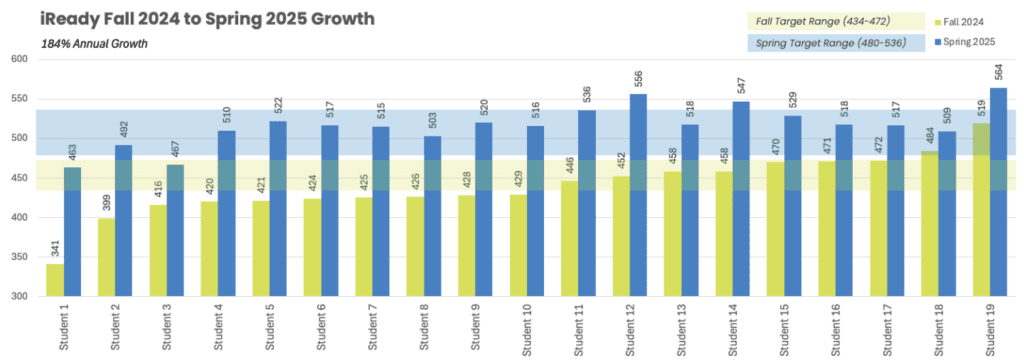
2024–2025 School Year (Bolton’s First Year Using EBLI):
Beginning of year (August 2024):
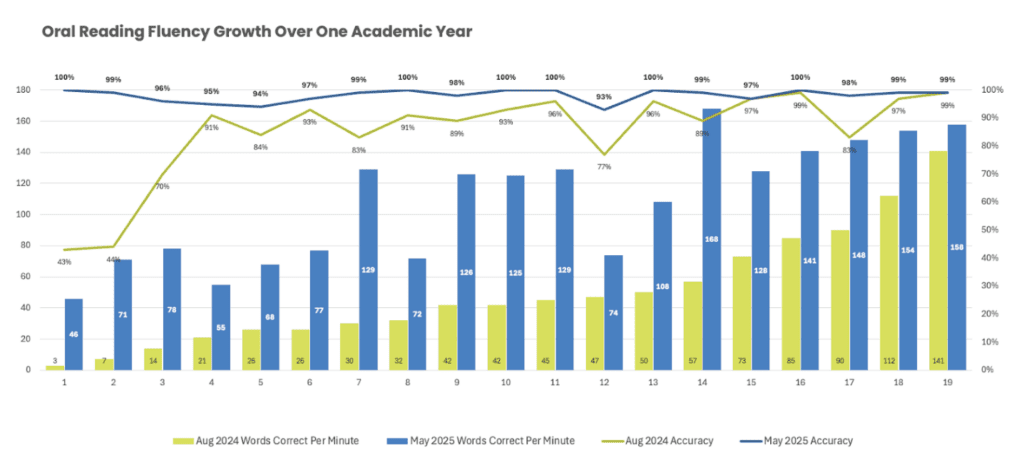
End of year (May 2025):
DIBELS Results 8th Edition – Correct Words Per Minute and Percent Accuracy


In September 2025, Bolton shared this reflection on her experience with EBLI:

Stephane is the first-grade supervising teacher at Kilby Laboratory School, a public laboratory school on the campus of the University of North Alabama in Florence, Alabama. Kilby is ranked among the top 5% of elementary schools in Alabama for overall test scores, with 80–84% of students achieving reading proficiency — compared to the state average of 47%.
Accomplishments:
Two articles about her EBLI experience published in peer-reviewed journals:
Recipient of ALA Outstanding Literacy Teacher Award, 2025
Founded Primary Patchwork Learning Center, 2025
Goyen Literacy Fellow, 2025
Presenter (by request), Alabama Literacy Association conference, Fall, 2025
Featured Holly Korbey’s “The Phonics Wars” article, February 2026
Bolton’s story matters because she is not a newcomer. She had decades of training in teaching reading, Science of Reading frameworks, and evidence-based practices before she found EBLI. She had already been doing the work. And yet, it was the shift to Linguistic Phonics — the speech-first, streamlined approach that EBLI uses — that closed the gap for the students she hadn’t been able to reach before.
Her experience mirrors what EBLI’s independent research has shown across larger studies: in a Michigan study of 815 students across 35 classrooms, 58% of K–4 students met fall-to-fall growth expectations with EBLI, compared to 42% in the pre-EBLI cohort. In a Massachusetts intervention study, 37% of students reached grade level and 88% passed the state assessment. And in Grand Rapids, the percentage of students at or above grade level rose from 40% to 70%.
Bolton’s classroom data adds a powerful individual case to this growing body of evidence — one teacher, one classroom, and the outcome every educator hopes for: every student reading.
See the full research behind EBLI: View Evidence

“EBLI has completely transformed the way I teach and the way my students learn. During my first year using EBLI, every child in my class experienced remarkable growth…”

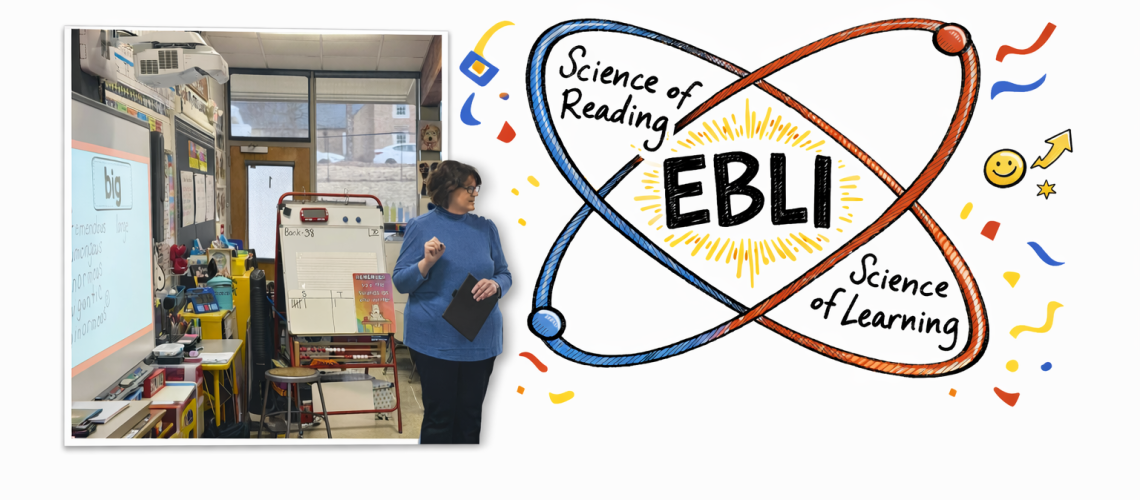
For over a century, educators have been searching for the best way to teach children to read. This blog will explore two approaches to literacy:
“I don’t understand what EBLI is and how it is different.” Although EBLI has been around for over two decades, there’s been a sharp increase